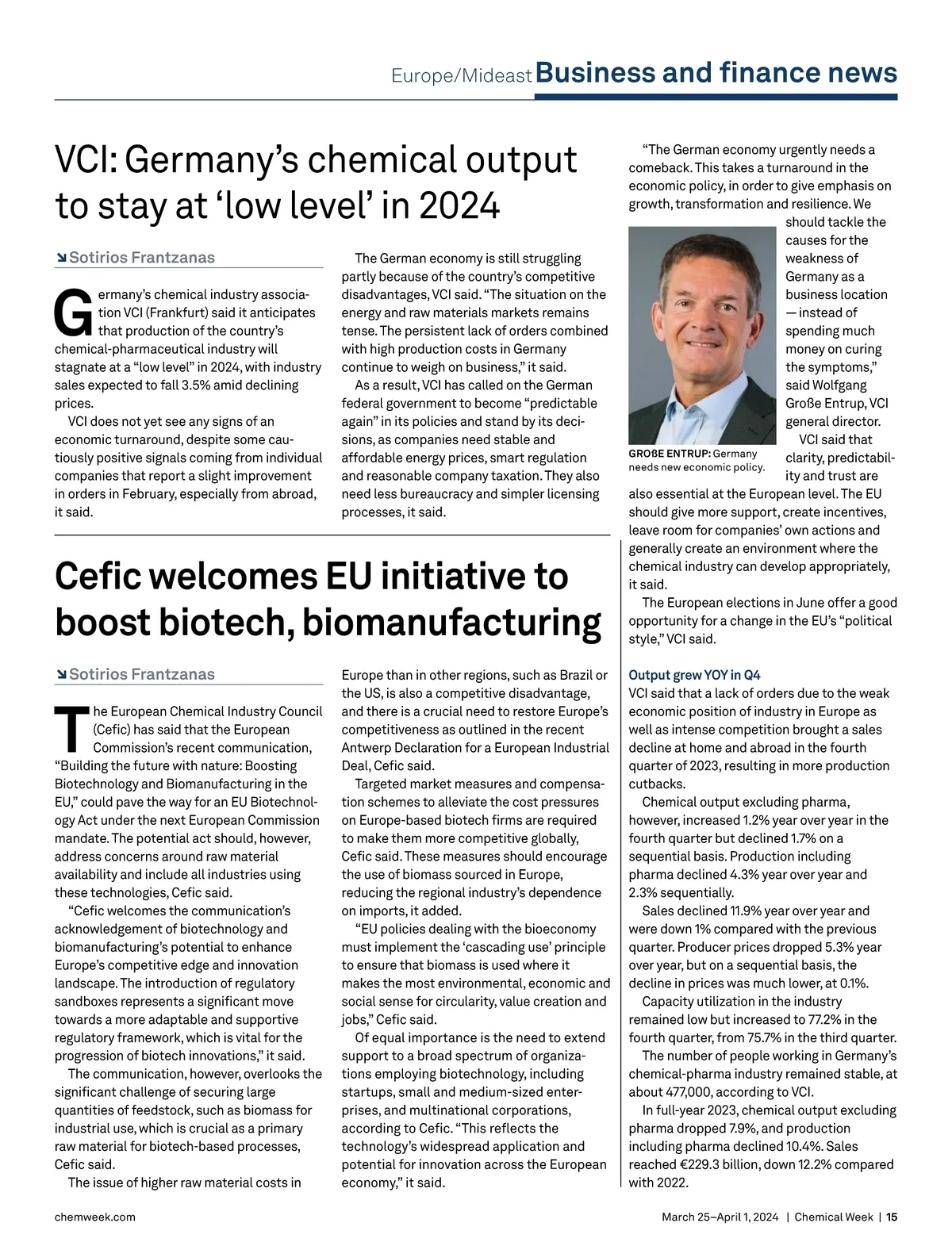
Europe/Mideast Business and finance news VCI: Germany’s chemical output to stay at ‘low level’ in 2024 G ↘ Sotirios Frantzanas ermany’s chemical industry associa-tion VCI (Frankfurt) said it anticipates that production of the country’s chemical-pharmaceutical industry will stagnate at a “low level” in 2024, with industry sales expected to fall 3.5% amid declining prices. VCI does not yet see any signs of an economic turnaround, despite some cau-tiously positive signals coming from individual companies that report a slight improvement in orders in February, especially from abroad, it said. The German economy is still struggling partly because of the country’s competitive disadvantages, VCI said. “The situation on the energy and raw materials markets remains tense. The persistent lack of orders combined with high production costs in Germany continue to weigh on business,” it said. As a result, VCI has called on the German federal government to become “predictable again” in its policies and stand by its deci-sions, as companies need stable and affordable energy prices, smart regulation and reasonable company taxation. They also need less bureaucracy and simpler licensing processes, it said. Cefic welcomes EU initiative to boost biotech, biomanufacturing “The German economy urgently needs a comeback. This takes a turnaround in the economic policy, in order to give emphasis on growth, transformation and resilience. We should tackle the causes for the weakness of Germany as a business location — instead of spending much money on curing the symptoms,” said Wolfgang Große Entrup, VCI general director. VCI said that GROßE ENTRUP: Germany clarity, predictabil-needs new economic policy. ity and trust are also essential at the European level. The EU should give more support, create incentives, leave room for companies’ own actions and generally create an environment where the chemical industry can develop appropriately, it said. The European elections in June offer a good opportunity for a change in the EU’s “political style,” VCI said. Output grew YOY in Q4 VCI said that a lack of orders due to the weak economic position of industry in Europe as well as intense competition brought a sales decline at home and abroad in the fourth quarter of 2023, resulting in more production cutbacks. Chemical output excluding pharma, however, increased 1.2% year over year in the fourth quarter but declined 1.7% on a sequential basis. Production including pharma declined 4.3% year over year and 2.3% sequentially. Sales declined 11.9% year over year and were down 1% compared with the previous quarter. Producer prices dropped 5.3% year over year, but on a sequential basis, the decline in prices was much lower, at 0.1%. Capacity utilization in the industry remained low but increased to 77.2% in the fourth quarter, from 75.7% in the third quarter. The number of people working in Germany’s chemical-pharma industry remained stable, at about 477,000, according to VCI. In full-year 2023, chemical output excluding pharma dropped 7.9%, and production including pharma declined 10.4%. Sales reached €229.3 billion, down 12.2% compared with 2022. March 25–April 1, 2024 | Chemical Week | 15 T ↘ Sotirios Frantzanas he European Chemical Industry Council (Cefic) has said that the European Commission’s recent communication, “Building the future with nature: Boosting Biotechnology and Biomanufacturing in the EU,” could pave the way for an EU Biotechnol-ogy Act under the next European Commission mandate. The potential act should, however, address concerns around raw material availability and include all industries using these technologies, Cefic said. “Cefic welcomes the communication’s acknowledgement of biotechnology and biomanufacturing’s potential to enhance Europe’s competitive edge and innovation landscape. The introduction of regulatory sandboxes represents a significant move towards a more adaptable and supportive regulatory framework, which is vital for the progression of biotech innovations,” it said. The communication, however, overlooks the significant challenge of securing large quantities of feedstock, such as biomass for industrial use, which is crucial as a primary raw material for biotech-based processes, Cefic said. The issue of higher raw material costs in chemweek.com Europe than in other regions, such as Brazil or the US, is also a competitive disadvantage, and there is a crucial need to restore Europe’s competitiveness as outlined in the recent Antwerp Declaration for a European Industrial Deal, Cefic said. Targeted market measures and compensa-tion schemes to alleviate the cost pressures on Europe-based biotech firms are required to make them more competitive globally, Cefic said. These measures should encourage the use of biomass sourced in Europe, reducing the regional industry’s dependence on imports, it added. “EU policies dealing with the bioeconomy must implement the ‘cascading use’ principle to ensure that biomass is used where it makes the most environmental, economic and social sense for circularity, value creation and jobs,” Cefic said. Of equal importance is the need to extend support to a broad spectrum of organiza-tions employing biotechnology, including startups, small and medium-sized enter-prises, and multinational corporations, according to Cefic. “This reflects the technology’s widespread application and potential for innovation across the European economy,” it said.
Chemical Week March 25/April 1: Page 15