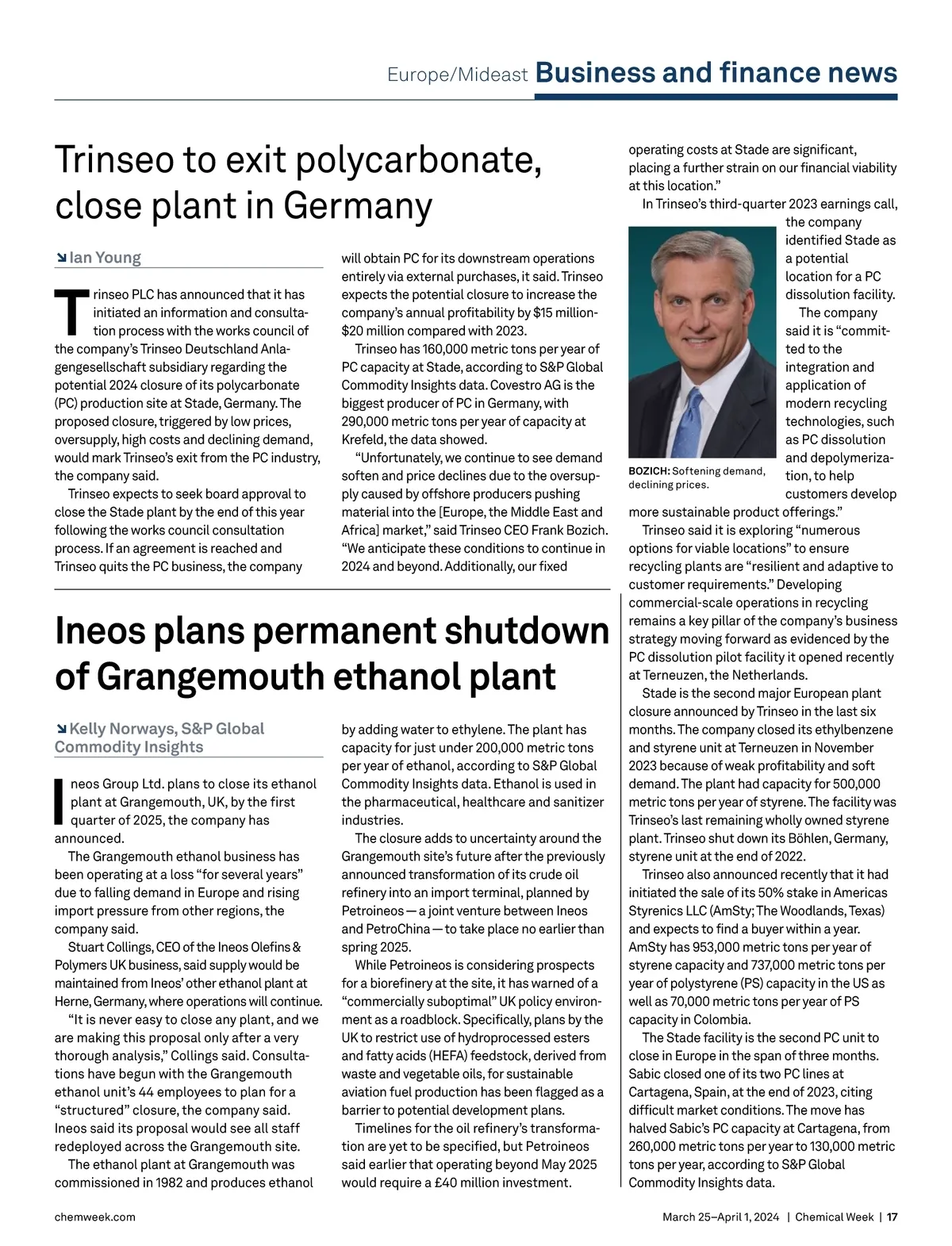
Europe/Mideast Business and finance news operating costs at Stade are significant, placing a further strain on our financial viability at this location.” In Trinseo’s third-quarter 2023 earnings call, the company identified Stade as a potential location for a PC dissolution facility. The company said it is “commit-ted to the integration and application of modern recycling technologies, such as PC dissolution and depolymeriza-BOZICH: Softening demand, tion, to help declining prices. customers develop more sustainable product offerings.” Trinseo said it is exploring “numerous options for viable locations” to ensure recycling plants are “resilient and adaptive to customer requirements.” Developing commercial-scale operations in recycling remains a key pillar of the company’s business strategy moving forward as evidenced by the PC dissolution pilot facility it opened recently at Terneuzen, the Netherlands. Stade is the second major European plant closure announced by Trinseo in the last six months. The company closed its ethylbenzene and styrene unit at Terneuzen in November 2023 because of weak profitability and soft demand. The plant had capacity for 500,000 metric tons per year of styrene. The facility was Trinseo’s last remaining wholly owned styrene plant. Trinseo shut down its Böhlen, Germany, styrene unit at the end of 2022. Trinseo also announced recently that it had initiated the sale of its 50% stake in Americas Styrenics LLC (AmSty; The Woodlands, Texas) and expects to find a buyer within a year. AmSty has 953,000 metric tons per year of styrene capacity and 737,000 metric tons per year of polystyrene (PS) capacity in the US as well as 70,000 metric tons per year of PS capacity in Colombia. The Stade facility is the second PC unit to close in Europe in the span of three months. Sabic closed one of its two PC lines at Cartagena, Spain, at the end of 2023, citing difficult market conditions. The move has halved Sabic’s PC capacity at Cartagena, from 260,000 metric tons per year to 130,000 metric tons per year, according to S&P Global Commodity Insights data. March 25–April 1, 2024 | Chemical Week | 17 Trinseo to exit polycarbonate, close plant in Germany T ↘ Ian Young rinseo PLC has announced that it has initiated an information and consulta-tion process with the works council of the company’s Trinseo Deutschland Anla-gengesellschaft subsidiary regarding the potential 2024 closure of its polycarbonate (PC) production site at Stade, Germany. The proposed closure, triggered by low prices, oversupply, high costs and declining demand, would mark Trinseo’s exit from the PC industry, the company said. Trinseo expects to seek board approval to close the Stade plant by the end of this year following the works council consultation process. If an agreement is reached and Trinseo quits the PC business, the company will obtain PC for its downstream operations entirely via external purchases, it said. Trinseo expects the potential closure to increase the company’s annual profitability by $15 million-$20 million compared with 2023. Trinseo has 160,000 metric tons per year of PC capacity at Stade, according to S&P Global Commodity Insights data. Covestro AG is the biggest producer of PC in Germany, with 290,000 metric tons per year of capacity at Krefeld, the data showed. “Unfortunately, we continue to see demand soften and price declines due to the oversup-ply caused by offshore producers pushing material into the [Europe, the Middle East and Africa] market,” said Trinseo CEO Frank Bozich. “We anticipate these conditions to continue in 2024 and beyond. Additionally, our fixed Ineos plans permanent shutdown of Grangemouth ethanol plant I ↘ Kelly Norways, S&P Global Commodity Insights neos Group Ltd. plans to close its ethanol plant at Grangemouth, UK, by the first quarter of 2025, the company has announced. The Grangemouth ethanol business has been operating at a loss “for several years” due to falling demand in Europe and rising import pressure from other regions, the company said. Stuart Collings, CEO of the Ineos Olefins & Polymers UK business, said supply would be maintained from Ineos’ other ethanol plant at Herne, Germany, where operations will continue. “It is never easy to close any plant, and we are making this proposal only after a very thorough analysis,” Collings said. Consulta-tions have begun with the Grangemouth ethanol unit’s 44 employees to plan for a “structured” closure, the company said. Ineos said its proposal would see all staff redeployed across the Grangemouth site. The ethanol plant at Grangemouth was commissioned in 1982 and produces ethanol chemweek.com by adding water to ethylene. The plant has capacity for just under 200,000 metric tons per year of ethanol, according to S&P Global Commodity Insights data. Ethanol is used in the pharmaceutical, healthcare and sanitizer industries. The closure adds to uncertainty around the Grangemouth site’s future after the previously announced transformation of its crude oil refinery into an import terminal, planned by Petroineos — a joint venture between Ineos and PetroChina — to take place no earlier than spring 2025. While Petroineos is considering prospects for a biorefinery at the site, it has warned of a “commercially suboptimal” UK policy environ-ment as a roadblock. Specifically, plans by the UK to restrict use of hydroprocessed esters and fatty acids (HEFA) feedstock, derived from waste and vegetable oils, for sustainable aviation fuel production has been flagged as a barrier to potential development plans. Timelines for the oil refinery’s transforma-tion are yet to be specified, but Petroineos said earlier that operating beyond May 2025 would require a £40 million investment.
Chemical Week March 25/April 1: Page 17